Proven Techniques And Worksheets for Rational Emotive Behavior Therapy from Icarus Wellness & Recovery
Our Rational Emotive Behavior Therapy (REBT therapy) worksheets offer you a practical, structured way to make sense of your beliefs and thoughts that can mold your emotional responses and behaviors. Therapists and clinical psychologists use worksheets to help clients in therapy sessions as they reflect on triggers, responses, and consequences.
The clinical team at Icarus Wellness and Recovery in Boise, Idaho, uses REBT therapy worksheets and PDFs to make the therapeutic process easier; clients understand the causes of their irrational beliefs or thoughts as they explore them with a therapist.
We invite you to continue reading to learn how REBT therapy handouts in our accredited treatment setting and download our REBT PDFs to complete and share with your therapist.
Get Confidential Trauma and Mental Health Assessment
The ABC Model Connects Emotional Responses to Activating Events
The ABC model is common in psychotherapy sessions. It helps empower clients to consider:
- Activating events: These events are what actually happened – or what you noticed about them. You’ll consider the trigger that set things into motion. These should be based in evidence and facts, not fears or opinions.
- Beliefs about a situation: This component refers to your thoughts, assumptions, or the meaning you assigned to the event.
- Consequences of their response to the event: These are the behavioral outcomes; what did you do or how did you respond?
As they work through the process, they start recognizing how negative thinking leads to emotional reactions. With practice, clients gain self-awareness and see how their negativity can harm their ability to cope in daily life.
Our REBT Challenging Questions Worksheets
Mental health treatment professionals use REBT therapy worksheets as supportive tools to empower clients as they learn to reject irrational thoughts and replace them with rational thinking.
They help keep the patient focused on developing thought patterns and beliefs that will lead to balanced behaviors. The process is called cognitive restructuring
Our worksheets guide you through the ABC Model and a reflection on changed thought patterns. Once you master the ability to analyze negative emotions and thought patterns, you gain a valuable coping technique that you’ll carry for life.
ABC Model Worksheet for Cognitive Restructuring

As you write down the answers in this first sheet, take time to reflect and recognize your negative thoughts. In the first step, section “A,” focus on the facts of the activating event, not your feelings about it.
In step “B,” you identify the negative feelings and thought patterns that emerged as you experienced the event without guilt or shame. In “C,” write an honest assessment of how these negative thoughts impacted you.
REBT: Beliefs and Emotional Disturbance Check-in Handout
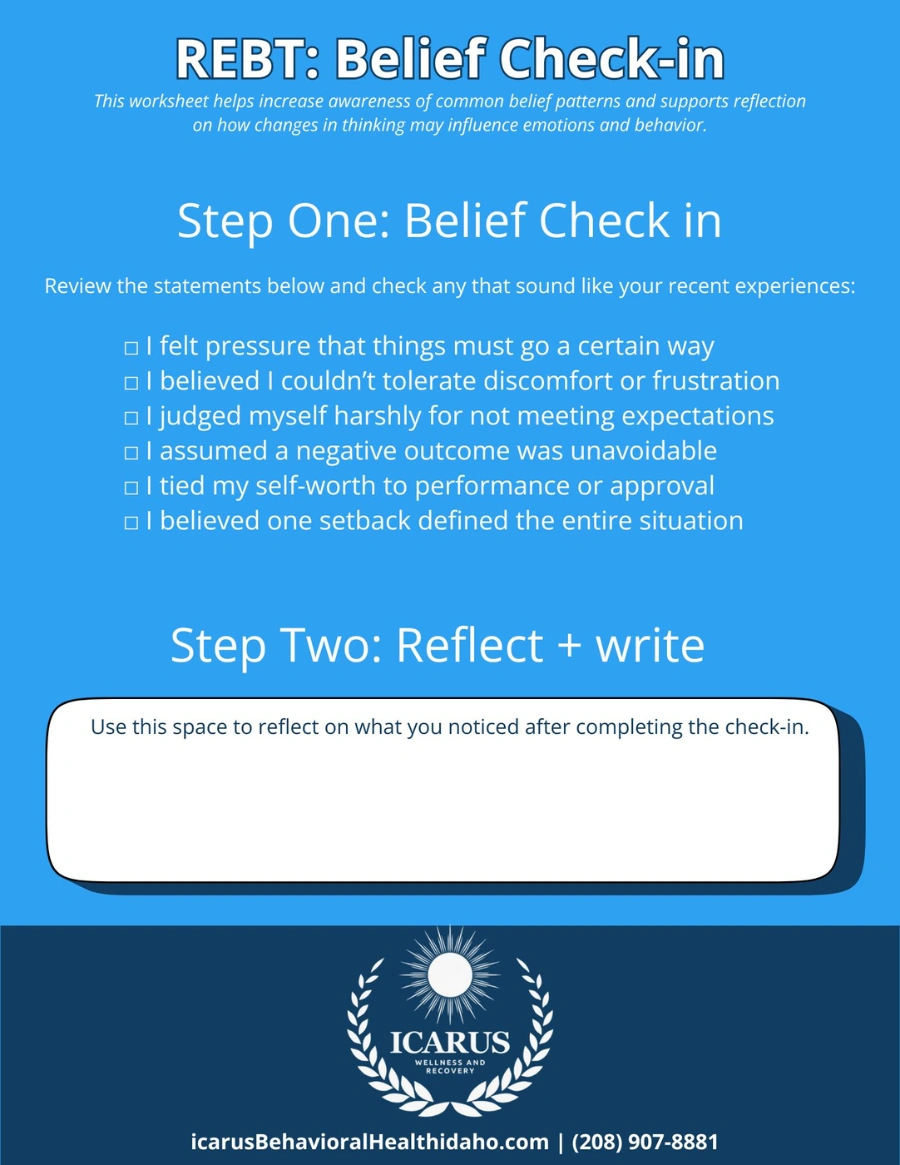
This REBT sheet asks you to check in after completing the first worksheet. Step one asks you to check off information about your feelings, reinforcing what you’ve already written about; in some cases, the checkboxes may help you identify secondary feelings.
In step 2, you will reflect on the process of reshaping your negative thoughts into balanced, rational beliefs.
How REBT Worksheets Are Used in Professional Treatment Settings
REBT worksheets are NOT a replacement for professional therapy. Instead, they are tools that enhance the treatment. Therapists use these exercises during sessions or as “homework,” to keep the tools sharp between appointments. The decision to use REBT is part of a holistic, individualized treatment program.
Get Accredited Treatment Programs at Icarus
A Brief Introduction to Rational Emotive Behavioral Therapy
Rational Emotive Behavior Therapy, REBT, is a form of cognitive behavior therapy. Albert Ellis developed the therapy in the mid-20th century when he recognized that emotional disturbances aren’t caused only by events but by the beliefs people hold about what happened.
His theory became the foundation of the Albert Ellis Institute, a research facility that continues to train psychology practitioners in his methods today.
Understanding Irrational Beliefs and Emotional Reactions
REBT explains how irrational beliefs and thoughts contribute to negative emotions, including anger, guilt, anxiety, and shame. The beliefs can lead to developing extreme conclusions or unrealistic expectations. These beliefs are rigid, making the emotional fallout more intense and disruptive to life.
This cognitive therapy helps you understand activating events clearly and examine how emotions lead to irrational responses. With time and practice, you learn to analyze events and hold healthier beliefs.
Common Cognitive Distortions That Shape Thought Patterns

People who experience mental health challenges often live with unhealthy thought patterns called cognitive distortions. Here are some common examples of those negative thought cycles:
All-or-nothing thinking
This mindset occurs when a person sees a situation in extremes, with no middle ground. They view things as a complete success or a total failure. An example is ‘Emma,’ 36, who many described as a classic overachiever. She was constantly on edge, striving to do everything perfectly.
To her, anything short of perfection was a zero. REBT exercises helped her relax and see that the all-or-nothing perfectionism was the cause of her anxiety and pain-pill addiction. Once she connected them, she opened up to the idea of making changes in therapy.
Catastrophic thoughts
Catastrophizing leads to an expectation of the worst possible outcome, even when there is no evidence that bad things will happen. ‘Josh,’ 25, adopted this mindset after surviving a terrifying trauma. He lived with flashbacks and nightmares, replaying the event in his mind at the worst times.
The REBT approach challenged Josh to seek evidence that his interpretations of the world were real. He worked hard and eventually learned that his traumatic event was a once-in-a-lifetime incident and that he was physically safe. He was able to teach himself to use the REBT tool to challenge all these thoughts when they creep back into his mind.
Overgeneralization
Overgeneralization happens when someone makes broad, general conclusions without having accurate or complete information. ‘Daniel,’ 42, is a good example. After losing a long-term job due to staffing cuts, he began to see himself as a failure and believed he’d never be able to find a good job again. He started drinking daily to cope with his shame.
In REBT, Daniel examined the belief behind his conclusions. He separated the job loss from his overall abilities. He saw that his negative thoughts were driving the hopelessness and drinking. That realization helped him complete therapy and re-enter the workforce.
Personalization
Personalization happens when someone assumes responsibility for events that are actually outside of their control. ‘Lena,’ 29, always blamed herself for other people’s moods or problems, assuming she’d done something wrong. It shattered her self-esteem and led to depression.
Using REBT tools, Lena finally understood that she was not responsible for other people’s reactions. She practiced questioning her assumptions and started to see that she was not to blame for everything. Now, Lena has self-love and healthier relationships with her friends and loved ones.
Increasing Awareness of Thoughts, Emotions, and Behaviors

Becoming more aware of thought patterns and emotions is a key goal of REBT. When people challenge negative thinking and understand how their internal thoughts shape behaviors, they can make lasting changes. With commitment, the REBT process supports healthier, more intentional responses and increases resilience.
What Coping Techniques Are Supported by REBT Principles?
REBT coping techniques focus on:
- Emotional regulation
- Problem solving
- Flexible thinking
Many clients choose REBT as part of a more comprehensive aftercare plan. The tools integrate seamlessly with other relapse prevention tools, like peer group meetings, meditation, and self-care strategies.
Stepping Outside the Comfort Zone to Build New Skills
Clients may initially hesitate before accepting REBT-informed techniques. The tools require you to step outside of your comfort zone, as many clients have never challenged their negative thoughts or feelings.
REBT therapists challenge clients to stop avoiding discomfort and build tolerance and confidence by confronting their internal struggles.
What Does REBT Help Treat as a Form of Behavioral Therapy?

REBT can help resolve many mental health conditions, including:
- Anxiety disorders
- Panic disorder
- Depressive disorders
- Anger and emotional dysregulation
- Trauma and PTSD
- Substance use disorders
- Eating disorders
- OCD (Obsessive-compulsive disorder)
It is a trauma-informed, evidence-based modality and is also beneficial in dual diagnosis treatment, with both mental health and substance use disorders being treated at once.
Further Resources and Workbooks from Our Expert Staff
Our clinical team and writers have partnered to create an array of resources (and worksheets) related to other helpful forms of therapy and therapeutic exercises. You can review the resources below:
- Music therapy worksheets
- Cognitive Processing Therapy worksheets
- IFS Therapy worksheets
- Recovery journal prompts
- with additional resources published regularly
Up To 100% of Rehab Costs Covered By Insurance
Get Supportive Treatment at Icarus Wellness & Recovery Today
Icarus Wellness and Recovery in Boise, Idaho, offers evidence-based therapies, including REBT. We help clients overcome one or more mental health conditions, treating each client to individually-tailored, holistic care in our comfortable, inclusive facility.
If you or a loved one needs mental health support, call us today. All calls are confidential, so please reach out for proven programs of assistance now.