
A Journaling Worksheet for Trauma Timelines
Our downloadable trauma timeline worksheet helps our adult clients construct a clear path for processing what happened that led them to mental health challenges. Confronting the past can be challenging, but it is a key part of moving forward.
At Icarus Wellness and Recovery, our mental health professionals understand that when a person has lived through traumatic experiences, the memories of the events can become fragmented and internalized. Instead of being able to recall things clearly, the past can feel like a chaotic collection of traumatic memories.
Our trauma timeline and narrative sheet can help clients identify their triggers, which is essential for managing symptoms during recovery from trauma. Feel free to print it out and use it if you’re struggling.
Please be aware that this an informal resource and is not a substitute for professional mental health support and does not constitute a clinician-client relationship.
Downloadable Trauma Timeline Worksheet Template PDF
Our downloadable resource will help you understand the impact of trauma on your life. While some people download worksheets and practice at home.
However, we agree with American Psychological Association (APA) guidelines, which strongly suggest you complete this trauma exposure exercise in the context of a professional mental health setting.
Step 1: Prepare to Manage Traumatic Memories Through Grounding
Before you start the worksheet, take a few minutes to create a sense of safety. Grounding is the ability to stay tethered in the here and now, even if the past starts to pull you in.
For example, you might notice your body start to feel numb or cold while recalling a traumatic experience or events that put you in danger. That is a typical response to memory recall, especially after years of avoidance.
To overcome this, you will have a grounding technique ready to use. It’s helpful to have that technique ready in your mind before you start; you can also note it in the margin if you fear you’ll forget it.
Performing this quick exercise interrupts the brain’s panic response. As you do the technique, you shift from the “survival brain” (amygdala) back to the “logical brain” (prefrontal cortex). You will feel more in control of your emotions and become ready to focus on your worksheet.
Step 2: Plot Traumatic Events on a Trauma Timeline
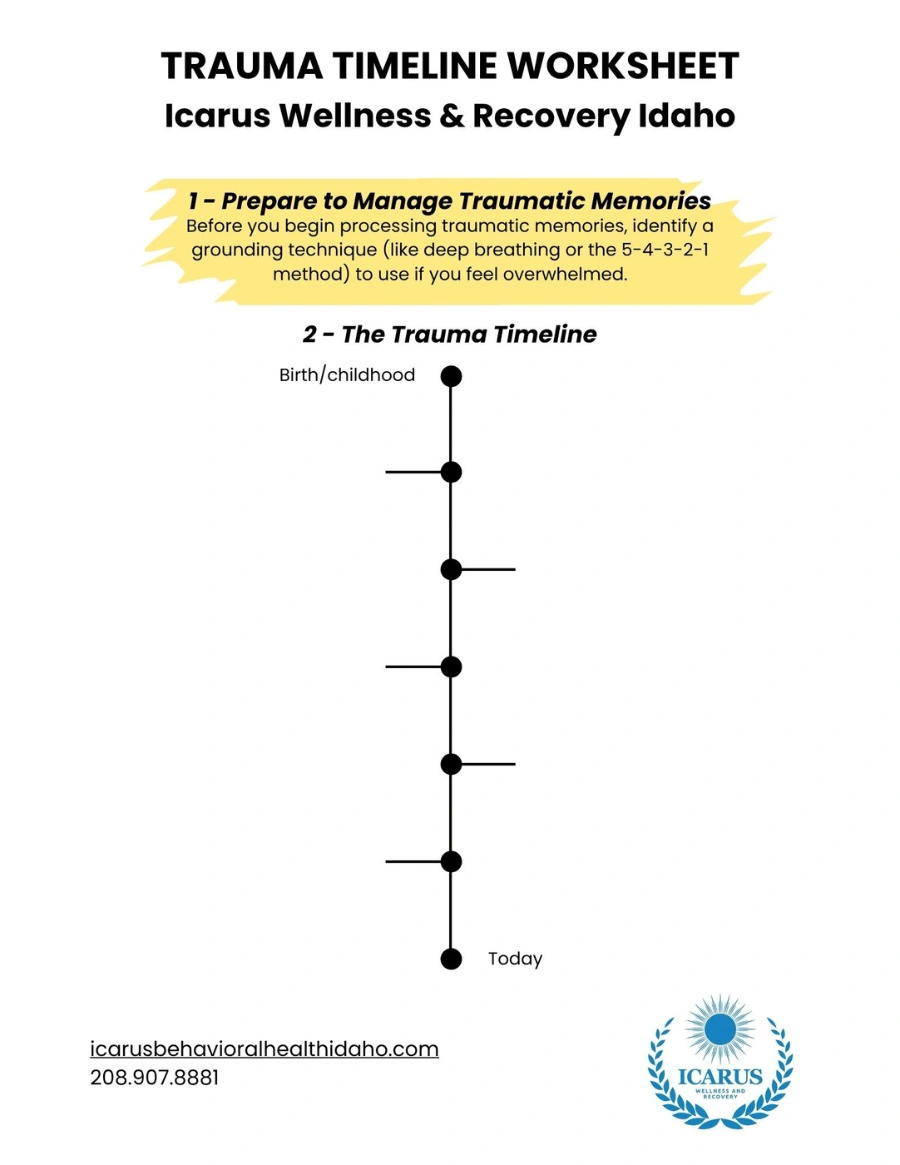
The Trauma Timeline Worksheet is designed to visually represent the events leading up to and following a traumatic event. It can help you recall details you might not remember otherwise.
Use the vertical line on page 1 to chart your key traumatic events, even those you experienced as a child. Marking these points in order helps you process them almost as if you are viewing them as a third party. You become the narrator of your life story instead of feeling like a character in a tragedy.
Don’t rush as you track these events. Give yourself enough time to acknowledge the importance of each point. You are not merely listing things that led to regret or pain. Instead, you are gaining deeper insight into your life story.
Print out an additional page 1 if you need more space to list your traumatic events.
Step 3: Externalize the Past by Writing Your Trauma Narrative
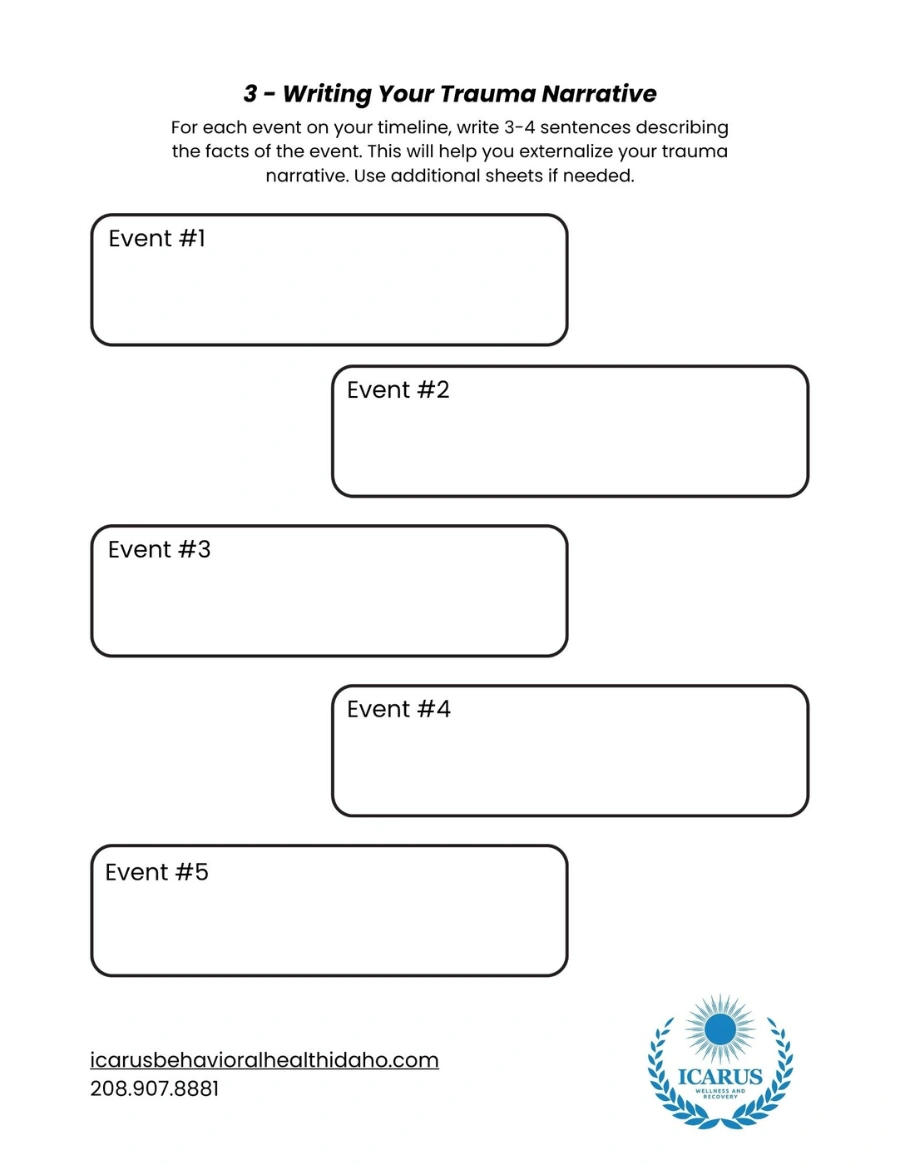
After mapping the points, you’ll reclaim your power over them by writing the trauma narrative. Keeping your story inside can lead to internal conflicts and mental health struggles. When you write them down, you teach yourself how to externalize those memories.
Don’t worry about perfection as you start this part of the exercise. Get your story on paper without concerns about grammar or spelling. The work lives in the process, not in a perfect outcome.
The process of writing a trauma narrative involves initially focusing on the facts of the traumatic experience, followed by adding thoughts and feelings. To make it more precise, you may go a step further, revising the narrative to include deeper emotional insights (optional).
Step 4: Heal by Identifying Your Personal Strengths
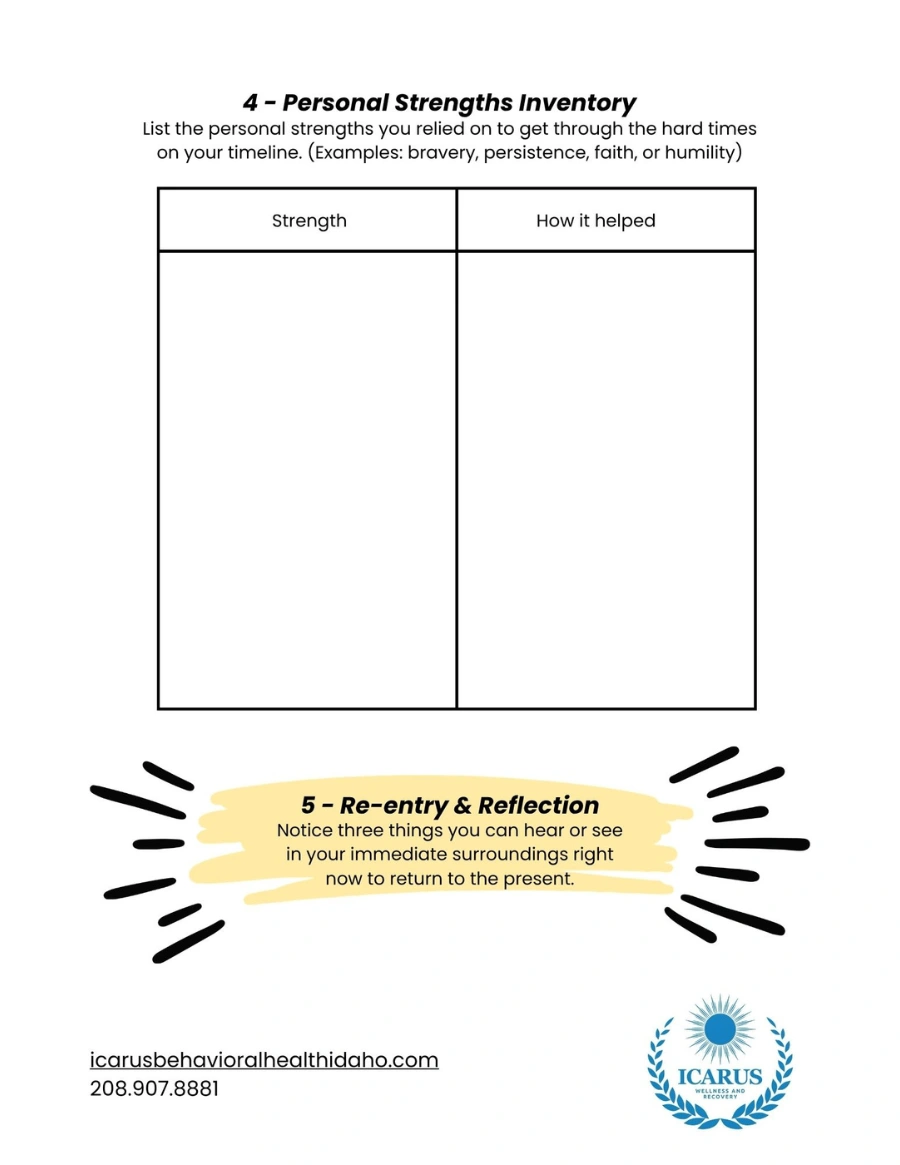
Some clients focus so much on the symptoms of trauma that they forget about the strengths that helped them act in ways that ensured survival. In this section, you look at your timeline and ask how you got through each trauma listed on the PDF.
For example, if you were neglected by your parents, your strength may have been resilience or imagination. If you struggled after a difficult divorce, you might list perseverance. Knowing your personal strengths can help you see that you do have the ability to cope with your current challenges.
Step 5: Reflect and Re-enter the Present After You Explore the Trauma
The final section of the trauma timeline worksheet guides you as you leave the past behind and rejoin the present. We encourage you to look around your immediate area.
Notice three things you can see, hear, or touch in your environment. Writing those things down brings your body and mind back into alignment in the now. This step is a vital form of self-care and minimizes any “emotional hangover” that might follow this deep trauma healing work.
Get Accredited Treatment Programs at Icarus
Tips for Completing a Trauma Timeline and Narrative Worksheet
Here are some tips for staying safe as you explore and list your traumatic memories:
- We encourage you to create your trauma timeline in a safe environment to minimize distress. It is best to work with a mental health professional, who can help you as you experience emotional and physical responses that may arise as you fill in your worksheet.
- Pacing and safety are essential when using the trauma timeline worksheet to prevent overwhelming emotions.
- Creating a trauma narrative typically requires several sessions, with the speed of progress determined by the client’s comfort level and the amount of detail shared.
- Worksheets designed for trauma therapy often include exercises for self-regulating emotions. These are crucial for clients who may experience unpredictable emotional responses after trauma. Don’t skip those sections!
What are the Benefits of a Completed Trauma Timeline Worksheet?

Research by psychologists Richard Tedeschi and Lawrence Calhoun in the mid-1990s established that the severe psychological struggle following major life crises can lead to positive growth and resilience.
Doctors Tedeschi and Calhoun define five specific domains of self-growth:
- Personal Strength: Feeling stronger because of what you survived.
- New Possibilities: Finding a new path in life.
- Improved Relationships: Closer ties with others who have suffered.
- Appreciation for Life: A changed sense of what is truly important.
- Spiritual/Existential Change: A deeper connection to one’s beliefs.
Their research proves that writing a trauma timeline and narrative is effective in promoting self-growth and processing traumatic experiences and emotions. Here are some of the benefits you may experience after putting the time into this exercise:
Track Post-Traumatic Growth
Post-Traumatic Growth (PTG) refers to the positive psychological changes that result from adversity and challenges, leading to personal growth and resilience. Your timeline shows where you started and how far you’ve come.
Recognize Your Strengths and Survival Skills
The use of a trauma timeline can aid in recognizing survival skills and positive coping strategies developed over time. Our worksheet asks you to list your strengths and consider how they helped you survive the trauma.
Document How Past Triggers Connect to Current Stress
Mapping events visually can help identify triggers and reveal connections between past experiences and current stressors. This awareness helps you prepare for long-term healing by developing appropriate coping strategies.
Build Self-compassion

A trauma timeline can foster self-compassion and help individuals let go of self-blame by integrating their life story. As you create the timeline and write the narrative, you process traumatic experiences and emotions in a way that shows you that the circumstances were not your fault.
Bridge to Better Communication
Trauma rarely impacts only the person who struggles. Many people we treat have loved ones, such as family members and close friends, who also feel concern for the person’s well-being. If you’re comfortable sharing it, your trauma workbook can help you share your experiences with trusted loved ones.
You will be able to hand them a document that explains the details without facing the exhaustion of retelling the whole story again. Your loved ones may walk away with a much clearer understanding of the challenges you face.
Of course, sharing is optional; it’s a highly individual choice.
Many Forms of Insurance Accepted
Call to Discuss Trauma Therapy and Find Support at Icarus Today
Our downloadable workbook is just one available tool for helping you confront your trauma. Our medical and mental health team will take a holistic approach to making your trauma manageable.
Treatment methods such as trauma-focused CBT and mindfulness training can help reduce the shame, anxiety, and fear that come from your trauma.
We accept most major insurance plans, and our admissions specialists will look specifically at your plan to ensure you can take advantage of all your benefits. We also accept self-pay clients.
Call Icarus Wellness and Recovery in Boise, Idaho, today to get the healing you deserve. Your call is free and confidential, so please reach out now for support and assistance.
References
- American Psychological Association (APA) Clinical Practice Guideline American Psychological Association. (2017). Clinical practice guideline for the treatment of posttraumatic stress disorder (PTSD) in adults. https://www.apa.org/ptsd-guideline/ptsd.pdf
- Speaking of Psychology Podcast with Richard Tedeschi, American Psychological Association. (2020, June). Speaking of psychology: Transformation after trauma, with Richard Tedeschi, PhD [Audio podcast episode]. https://www.apa.org/news/podcasts/speaking-of-psychology/transformation-trauma
- Lawrence G. Calhoun’s Research Profile (n.d.). Lawrence G. Calhoun’s research while affiliated with University of North Carolina at Charlotte and other places. https://www.researchgate.net/scientific-contributions/Lawrence-G-Calhoun-39977309