Reviewing and Understanding A Relapse in Your Recovery Journey
Relapse autopsy worksheet and PDF resources can help people slow down, reflect, and identify what turned a bad day into a deeper spiral. Recovery is not a neat, straight line. Factors like stress, anxiety, or isolation can disrupt the recovery routine and increase the risk of relapse. It can even happen to people in long-term sobriety.
The team at Icarus Wellness and Recovery in Boise, Idaho, understands that the struggle and cravings are real for people with an addiction. We recognize that clients in recovery have a lifelong medical condition that can be made worse by other conditions, often beyond their immediate control.
Mistakes happen. But when someone does make a mistake, it’s important to recognize the relapse patterns, take accountability, and update the sobriety plan.
We have created our relapse autopsy worksheet and PDF to help people get a clear picture of what went wrong and gain a better understanding of how to get back on track.
Get Accredited Treatment Programs at Icarus
Using Our Relapse Autopsy Worksheets for Better Mental Health
A relapse autopsy is a reflective process that helps people in recovery identify the causes and patterns related to their relapse. Actively seeking to understand the process and learn from their experiences helps people avoid repeating future occurrences.
The process of a relapse autopsy typically involves five steps:
- Identifying the conditions that contributed to the relapse
- Analyzing social or personal interactions that occurred before the relapse
- Examining what behavioral choices contributed to the situation
- Reflecting on emotional and psychological factors or triggers
- Refining or updating your prevention plan for the future
Our workbook combines these into three easy-to-understand worksheets. When you finish the sheets, you will have the data to help update your relapse prevention plan and continue on your recovery journey.
Worksheet 1: Understanding What Happened
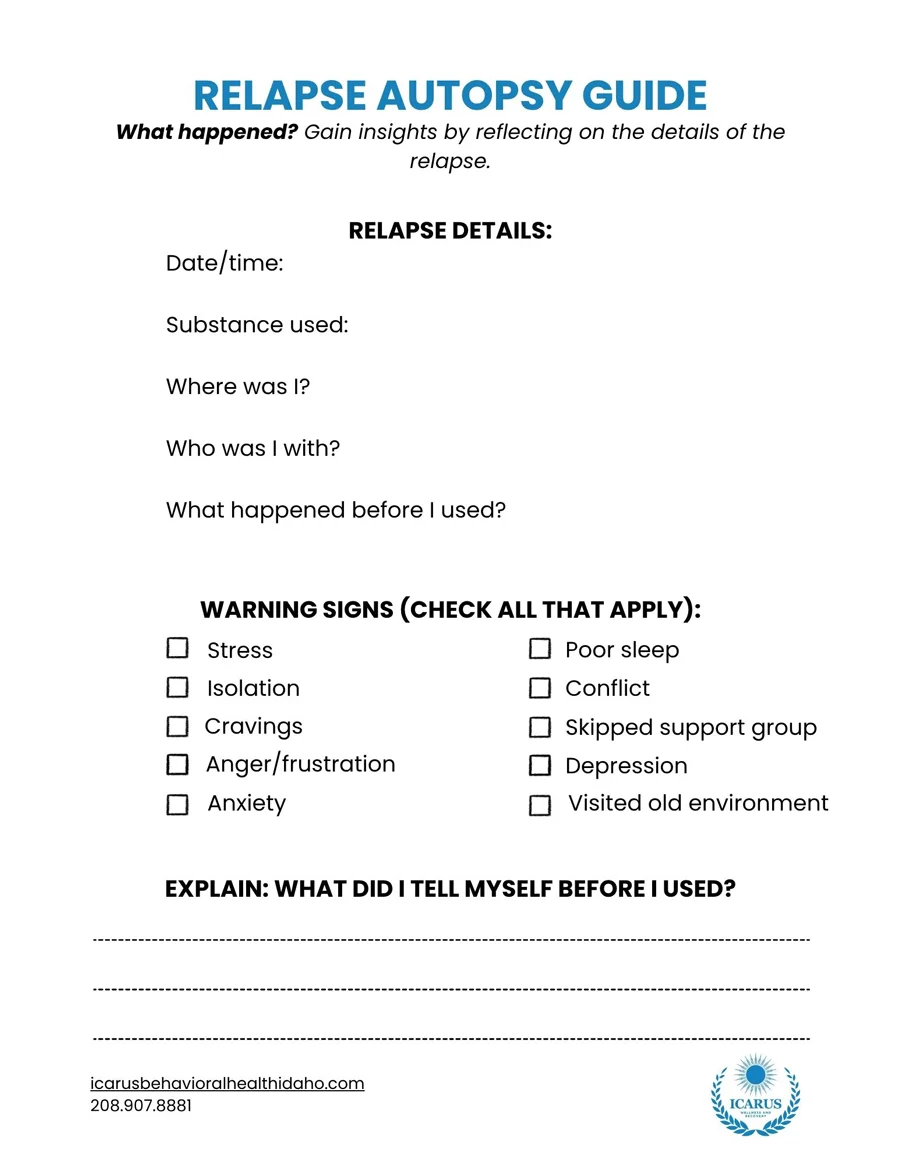
Our first worksheet helps clients look clearly at various aspects of the relapse without avoidance or shame. The goal isn’t to treat a mistake as failure, but to slow down and identify the people, places, emotions, or choices that caused it. Once written down, the information feels more like data points that can provide clues or answers about how to become more resilient.
What Interactions Happened Immediately Before the Relapse?
The first section considers what happened right before the relapse. It will differ for every person: a difficult conversation, conflict with family members, or life stress. Some people find that visiting with old friends or places where they once used substances can be a particular trigger point. As you complete this section, you will probably notice multiple contributing interactions, not a single event.
What Warning Signs or Symptoms Were Present?
Skipping the warning signs of emotional distress can add to the likelihood of a slip-up or relapse. Checking the boxes that indicate any signs you might have missed matters because a relapse is part of a progression of events. Assessing the warning signs this time can help you identify them sooner when you cope with triggers or cravings in the future.
What Did I Tell Myself Before Using Drugs or Alcohol?
This section helps you identify the self-talk that made relapse seem acceptable in that moment. For example, a person might think:
- “I can control my substance abuse.”
- “It won’t be my only mistake in life.”
- “I already messed up, so it doesn’t matter.”
You must label these thoughts honestly and clearly, because they weaken your recovery routine. Even better, these thoughts can be restructured in professional counseling sessions.
Worksheet 2: Resetting the Mind After a Mistake
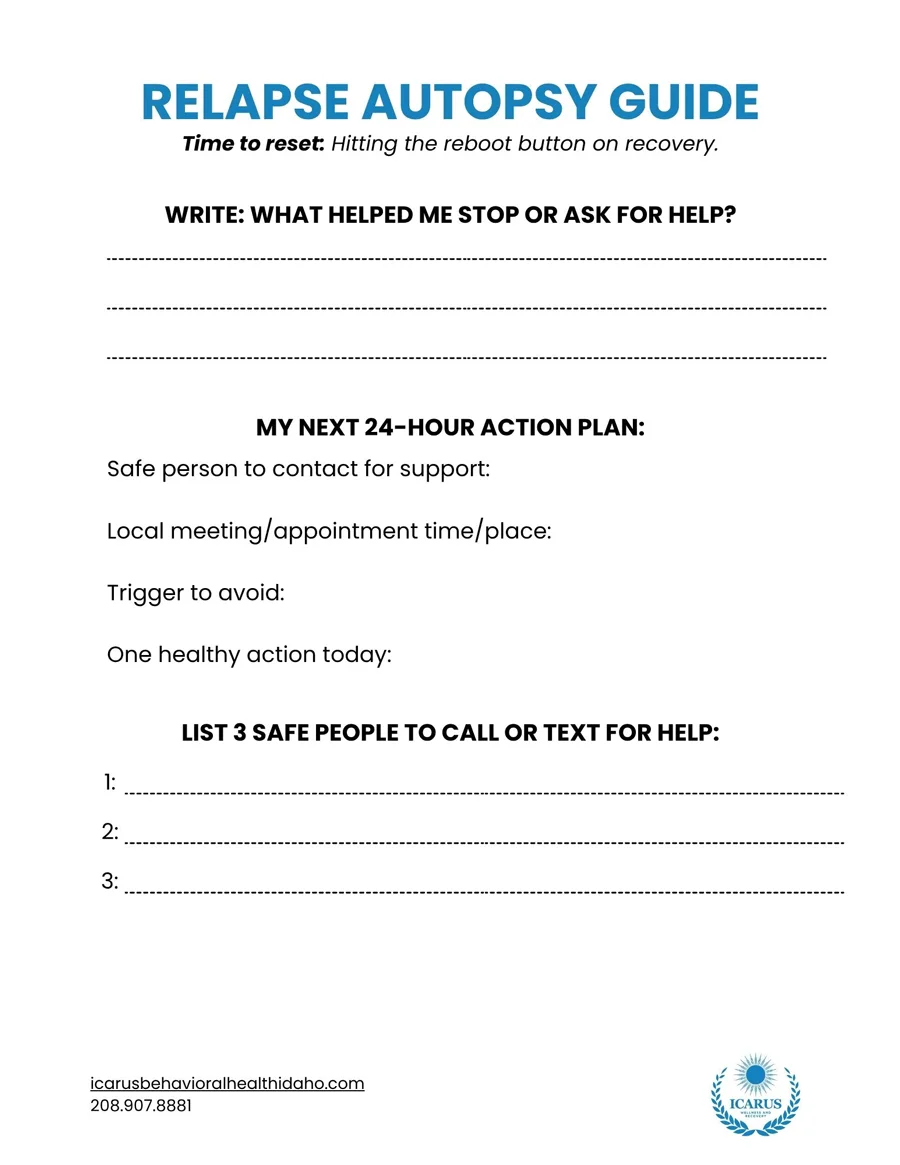
The second worksheet focuses on what happens directly following a relapse. The goal is to help the person stop the spiral and lower the danger level so they can take the right next steps. Relapse is serious, but it doesn’t mean total failure. In this step, you take accountability for the mistake and return to your recovery plan.
What Helped Me Stop or Seek Help?
Naming the strategy that interrupted the relapse is important, as it shows which supports are still working effectively. You might have called a sober living sponsor or loved one, or attended a 12-step meeting. You intuitively knew what to do, which is valuable information you can build on in the future.
What Will I Do in the Next 24 Hours?
The 24 hours after a relapse are a time for seeking safety and re-stabilization. Keep things simple and practical. Let trusted friends know that you need support, go to counseling or a meeting, avoid triggers, eat and rest well. This PDF helps you recognize the importance of getting back to the basics of your recovery routine.
What Friends or Loved Ones Can I Call for Help?
Addiction thrives in secrecy. This section asks you to identify the people who will provide you with emotional and social support without enabling your behavior. If you start to feel cravings or urges to use again, these are the safe friends, recovery peers, or the treatment staff at Icarus Idaho to reach out to immediately. List the numbers and names of those who will stay by your side while also holding you accountable.
Worksheet 3: Moving Past the Relapse with Self-love
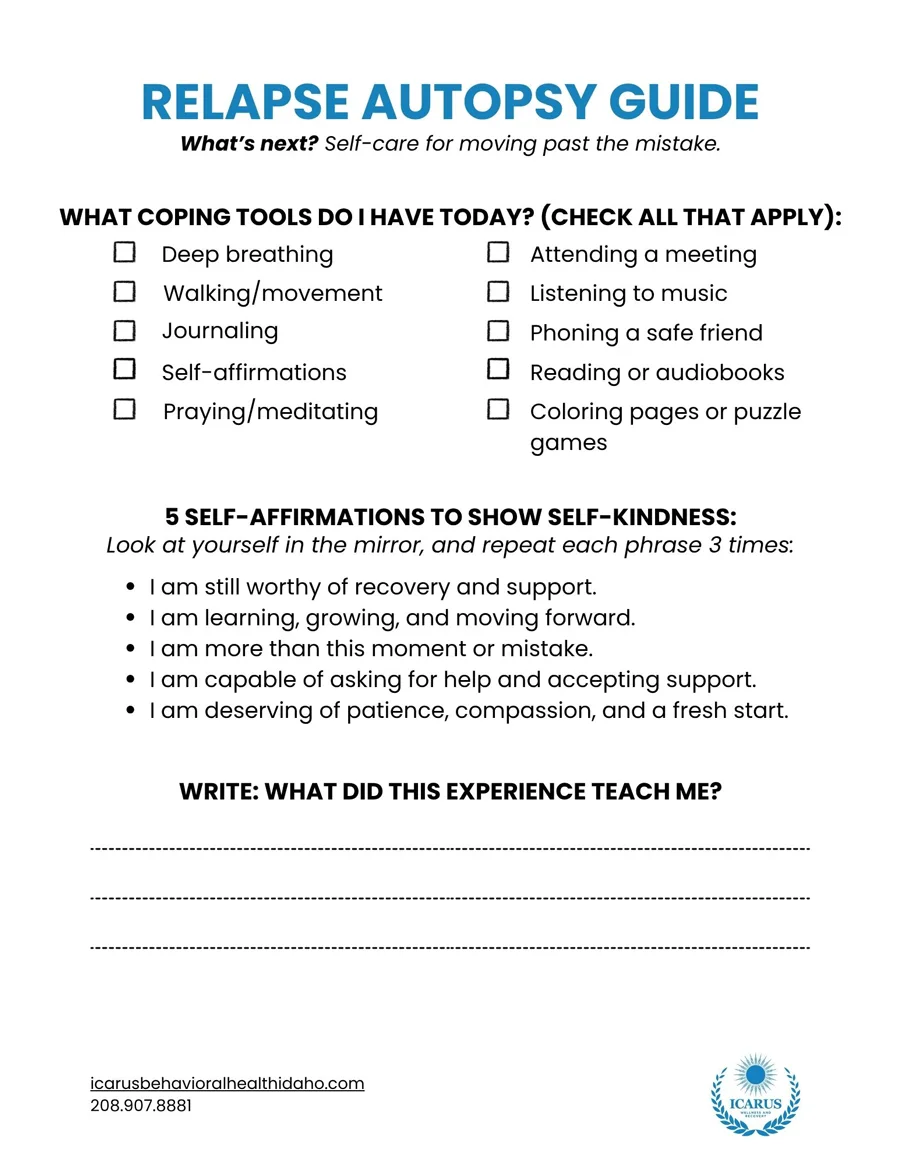
Bouncing back from a relapse isn’t easy; it requires you to be patient and kind with yourself. This worksheet helps you move from crisis-response mode to adjusting-and-learning mode.
What Coping Mechanisms Do I Already Have?
These checkboxes help you remember the tools you already use for managing your addiction in daily life. The activities that can help you manage distress or anxiety are the same tools that can distract you during a craving or when your emotions become difficult.
Using Self-affirmations to Show Self-kindness
Saying each of these self-affirming phrases in the mirror after a relapse can help challenge the harsh thoughts that often follow. Healthy self-talk can help you feel well enough to return to treatment and your recovery plan.
What Did the Relapse Teach Me?
The last section of the relapse autopsy worksheet turns the PDF into useful information as you move forward. It helps you spot anything that needs to be changed or updated in your aftercare plan. That can include a look at current relationships, environment, coping mechanisms, or daily routine.
We deliberately ask an open-ended question to challenge you to look at those things that cause the most challenges for you.
Using Additional Resources and Our Collection of Worksheets
In addition to our supportive resources on relapse prevention, Icarus Wellness and Recovery proudly offers a wide catalog of other worksheets that are used by clinicians and facilities nationwide. You can review our expansive collection below for additional support that meets your specific needs.
- Boundaries in recovery worksheets
- REBT therapy-assistive worksheets
- Trauma timeline worksheet
- Music therapy worksheets
- IFS therapy worksheets
- Recovery journal prompts
- With more published regularly, so please check back or message us suggestions as well.
Relapse Prevention Sheets Work Best When Used with a Therapist

Worksheets are always safest and most effective when used in conjunction with individual therapy. Therapists understand the emotions that contribute to a relapse, helping create effective, lasting strategies and making adjustments to the recovery plan along the way.
Clients at Icarus Wellness and Recovery receive individualized treatment plans from experienced professionals who consider the root causes of addiction. Whether the person’s substance abuse disorder came from unmanaged stress, trauma, or co-occurring conditions helps us create a recovery plan that addresses the addiction itself, along with any underlying needs.
Together, the tools and clinical supports offered by a professional treatment center can turn a relapse into useful information instead of untreated distress. The worksheets help the client put the experience into words. Therapy helps connect the answers to the larger treatment needs that may be driving the behavior. Working with a therapist makes the recovery plan a much stronger foundation for long-term sobriety.
How Relapses Occur
The stages of relapse are usually categorized into emotional, mental, and physical stages. Each stage represents a different level of risk and behavior. These don’t always occur suddenly; they often happen gradually over weeks or months before the person returns to substance abuse.
- During the emotional stage of relapse, individuals may experience poor self-care and engage in harmful behaviors without considering substance use, often accompanied by denial.
- In the mental stage of relapse, individuals may recognize their desire to use substances, leading to internal conflict and potential external turmoil, such as increased irritability or conflict with others.
- The physical stage of relapse is characterized by the actual return to substance use, often triggered by an opportunity where the individual believes they won’t get caught.
Medicaid and Many Forms of Insurance Accepted
Call Icarus Idaho for Customized Treatment Support
If you have been in recovery and have slipped up, you are not alone. You have not failed.
In fact, research by the National Council for Mental Wellbeing indicates that relapse rates for substances and alcohol range from 40-60%, similar to other chronic conditions, highlighting the need for ongoing support and adjustment of recovery plans.
Relapse prevention strategies and aftercare plans should evolve with the individual, as triggers and emotional responses can change. Our team can help you refine your treatment plan and avoid future relapses.
If you are ready to move forward with effective, lasting treatment, we’re here to provide evidence-based, customized treatment. Call the admissions team at Icarus Idaho for a free, confidential assessment of your needs today.
References
- Gorski, T. T. (1986). Staying sober: A guide for relapse prevention. Herald House/Independence Press.
- Marlatt, G. A., & Donovan, D. M. (Eds.). (2005). Relapse prevention: Maintenance strategies in the treatment of addictive behaviors (2nd ed.). Guilford Press.
- McLellan, A. T., Lewis, D. C., O’Brien, C. P., & Kleber, H. D. (2000). Drug dependence, a chronic medical illness: Implications for treatment, insurance, and outcomes evaluation. JAMA, 284(13), 1689–1695. https://doi.org/10.1001/jama.284.13.1689
- National Council for Mental Wellbeing. (2022). Access to care survey 2022. The Harris Poll. https://www.thenationalcouncil.org/news/more-than-4-in-10-us-adults-who-needed-substance-use-and-mental-health-care-did-not-get-treatment/
- National Institute on Drug Abuse. (2020). Drugs, brains, and behavior: The science of addiction — Treatment and recovery. U.S. Department of Health and Human Services. https://nida.nih.gov/publications/drugs-brains-behavior-science-addiction/treatment-recovery
- Substance Abuse and Mental Health Services Administration. (2023). Key substance use and mental health indicators in the United States: Results from the 2022 National Survey on Drug Use and Health (HHS Publication No. PEP23-07-01-006). Center for Behavioral Health Statistics and Quality. https://www.samhsa.gov/data/report/2022-nsduh-annual-national-report
- Witkiewitz, K., & Marlatt, G. A. (2004). Relapse prevention for alcohol and drug problems: That was Zen, this is Tao. American Psychologist, 59(4), 224–235. https://doi.org/10.1037/0003-066X.59.4.224