Practical Resources on Creating Effective Recovery Boundaries
The work of recovery asks a lot from you, especially in the early days: new habits, new routines, and often new ways of relating to the people closest to you.
One of the most practical skills you can build during this process is learning to set and maintain boundaries that protect your sobriety and your well-being.
This guide walks you through a complete set of printable worksheets designed by the Icarus Wellness and Recovery clinical team, explaining each page so you can put it to use right away.
Quick Core Takeaways
This article includes free, printable boundaries in recovery worksheet PDF descriptions created by the Icarus Wellness and Recovery clinical team. Each worksheet is described in full detail below so you know exactly what you are working with before you print.
- Healthy boundaries-physical, emotional, digital, time, and internal-are core relapse-prevention tools in addiction recovery and overall mental health
- The worksheets are step-by-step, fillable tools anyone can use at home, in a support group, or alongside a therapist to practice setting boundaries
- You will learn how to recognize unhealthy boundaries and patterns, script boundary conversations, and protect relationships with loved ones while safeguarding sobriety
- A boundaries in recovery worksheet is a structured self-reflection tool for addiction recovery that increases self-awareness and confidence in communication
Get Effective Treatment Support Options at Icarus
Understanding Boundaries in Recovery
Boundaries in recovery are the limits you set to protect your sobriety, emotional health, and physical safety after substance use, gambling, or other addictive behaviors. They define what is acceptable in relationships, what you will and won’t tolerate, and how you protect your personal needs during a vulnerable time.
Healthy boundaries are flexible, respectful, and mutual. Unhealthy boundaries fall into two camps: porous (saying yes to everything, tolerating disrespect, letting others push you into unsafe situations) and rigid (cutting everyone off entirely, refusing all help, isolating). During active addiction, emotional boundaries and physical boundaries often blur-you might tolerate substances in your home, share too much personal information with people you barely know, or take responsibility for a partner’s moods just to keep the peace.
Internal boundaries matter just as much as limits with others. These are promises you keep with yourself: not checking triggering social media accounts after 10 p.m., not going to a bar “just for food,” speaking to yourself with the same respect you would offer a friend. Setting boundaries is an act of self respect during recovery, and it is a skill you can learn.
At Icarus Wellness and Recovery, boundaries work is woven into one-to-one counseling, group therapy, and family sessions, and is a core component of our mental health treatment facilities in Idaho. The PDF worksheets described here are adapted from those clinical practices into plain language anyone can follow.
Why Healthy Boundaries Are Essential for Lasting Recovery

Boundary setting is a relapse-prevention skill, not a “nice to have.” Since around 2015, clinical programs have increasingly recognized that structured boundary training correlates with more stable abstinence, better emotional regulation, and higher self-efficacy.
Setting boundaries protects your emotional and physical well being-and healthy boundaries support long-term recovery success.
Here is how healthy boundaries in recovery help you:
- Avoid high-risk situations, like family gatherings or social events where alcohol is the focus
- Reduce stress, decrease resentment, and prevent resentment from building into burnout
- Protect emotional health by keeping emotional energy where it belongs
- Create room for healthier relationships and positive relationships built on mutual respect
Without clear boundaries, people in addiction recovery may over-caretake loved ones, say “yes” to everything, or stay connected to unsafe people. All of this can increase cravings and emotional overwhelm. You need to set limits on behaviors that may trigger a relapse, and these worksheets walk you through that process step by step.
Research-informed recovery programs show that people who learn boundary setting tend to report better mental health, more stable routines, and more confidence in saying no to triggers. Healthy boundaries help maintain sobriety and avoid triggers-and while they feel uncomfortable at first, they are a concrete, learnable skill.
What are the Core Types of Boundaries in Recovery? Learn How Each Works
The Icarus Wellness and Recovery clinical team works with several core boundary categories in individual and group settings. Types of boundaries include physical, emotional, and time boundaries, along with digital and internal categories that often go overlooked.
Here is how each one works in real life.
Physical boundaries protect your body, personal space, and physical well being:
- Not allowing substances in your home
- Asking people not to touch you without consent
- Choosing not to share your bed or room while in early sobriety
Emotional boundaries protect your feelings and mental health:
- Separating your own emotions from loved ones’ moods
- Not taking responsibility for others’ reactions to your choices
- Recognizing when emotional conversations feel too intense and need to pause
Digital boundaries limit online interactions that may trigger relapse:
- Limiting contact with people who use substances via text or social media
- Unfollowing triggering accounts
- Setting “do not disturb” windows at night, including limiting screen time to protect sleep and mental well-being
Time boundaries protect your schedule and emotional energy:
- Scheduling recovery activities, therapy, and self-care first
- Saying no to extra shifts or social events that conflict with recovery appointments
Internal boundaries are personal “rules” about money, honesty, self-discipline, and self-talk:
- No checking ex-partner’s social media when lonely
- No going to bars “just for food”
Social boundaries help manage interactions with others during recovery, and communication boundaries define acceptable topics and conversation styles in your relationships.
Find Accredited Treatment Programs at Icarus
Our Boundaries in Recovery Worksheet PDF Pack: Overview
This article outlines a multi-page, printable PDF workbook designed by the Icarus Wellness and Recovery clinical team for use in outpatient programs, support groups, and home practice.
A common worksheet structure includes identifying personal limits and recognizing boundary violations, and worksheets typically include identifying current boundaries and recognizing triggers.
The proposed worksheet packet structure:
- Page 1: Quick boundary check-in (self-assessment)
- Page 2: Mapping your current boundaries
- Pages 3–4: Designing new healthy boundaries
- Page 5: Communication scripts
- Page 6: Digital and internal boundaries planner
- Page 7: Weekly boundary review and reflection
The visual style features a clean black-and-white layout for easy printing, large open writing lines, and simple icons-a lock for safety, a heart for emotional boundaries, a phone for digital boundaries-to orient the reader at a glance.
The worksheets are written in everyday language, suitable for people in early sobriety, family members wanting to build healthy relationships, and clinicians looking for ready-to-use handouts. Using a boundaries worksheet can help increase self-awareness and confidence in communication. The following sections walk through each page in detail.
Worksheet 1: Boundaries Check‑In – Where Am I at Right Now?
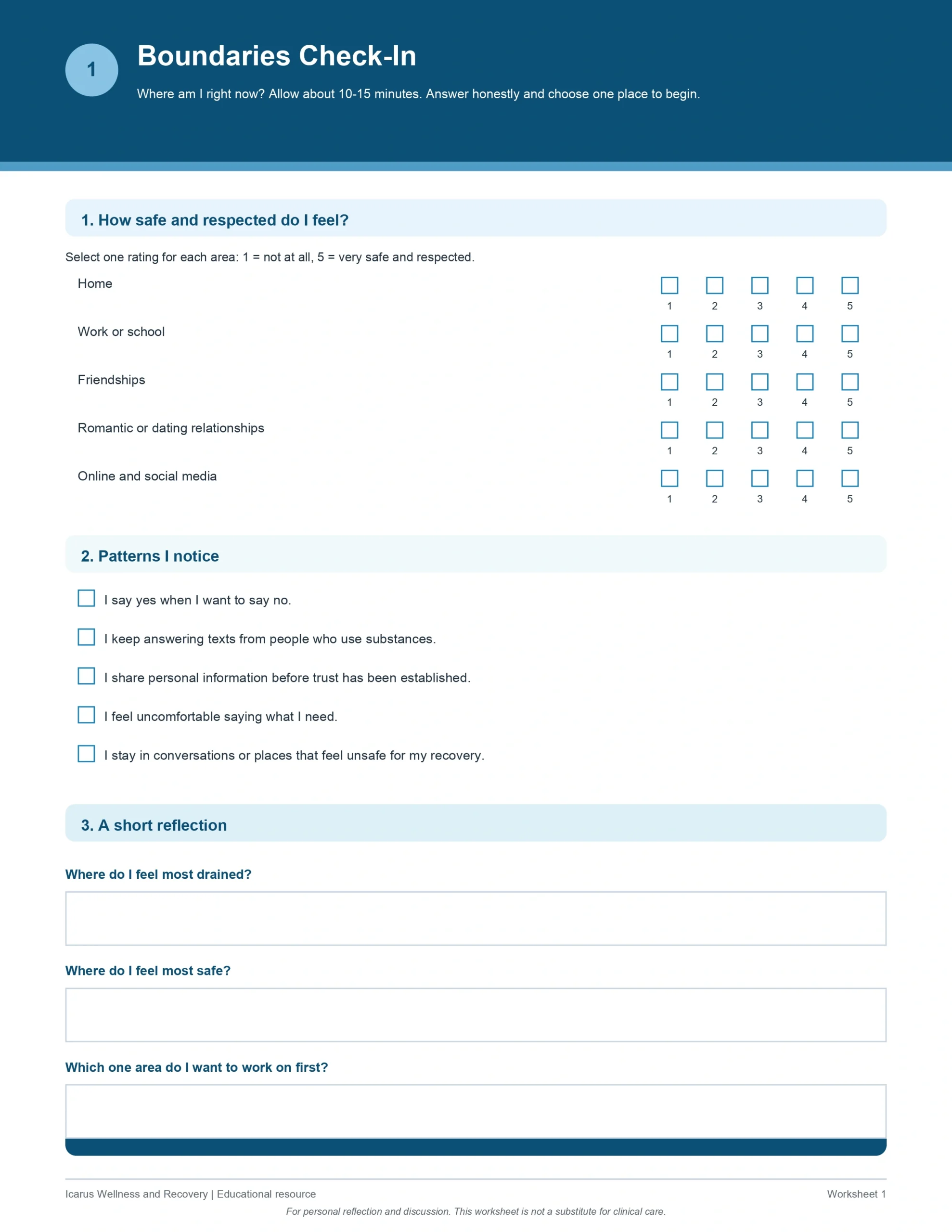
This one-page self-assessment is designed for day one. A short instruction paragraph at the top explains that it takes about 10–15 minutes to complete.
Section 1 uses a simple rating scale (1–5) where you circle how safe and respected you feel in key areas:
- Home
- Work or school
- Friendships
- Romantic or dating relationships
- Online / social media
Section 2 lists common boundary problems in recovery with checkboxes so you can quickly see patterns. Examples include:
- “I say yes when I want to say no”
- “I keep answering texts from people who use”
- “I share too much personal information with new people”
- “I feel uncomfortable saying what I actually need”
Section 3 offers brief journaling prompts with 3–4 lines each:
- “Where do I feel most drained?”
- “Where do I feel most safe?”
- “Which one area do I want to work on first?”
The page ends with a small reminder box in bold text: “You don’t have to fix everything at once. Pick one place to start.”
Worksheet 2: Map Your Current Boundaries in Terms of Physical, Emotional, and Digital
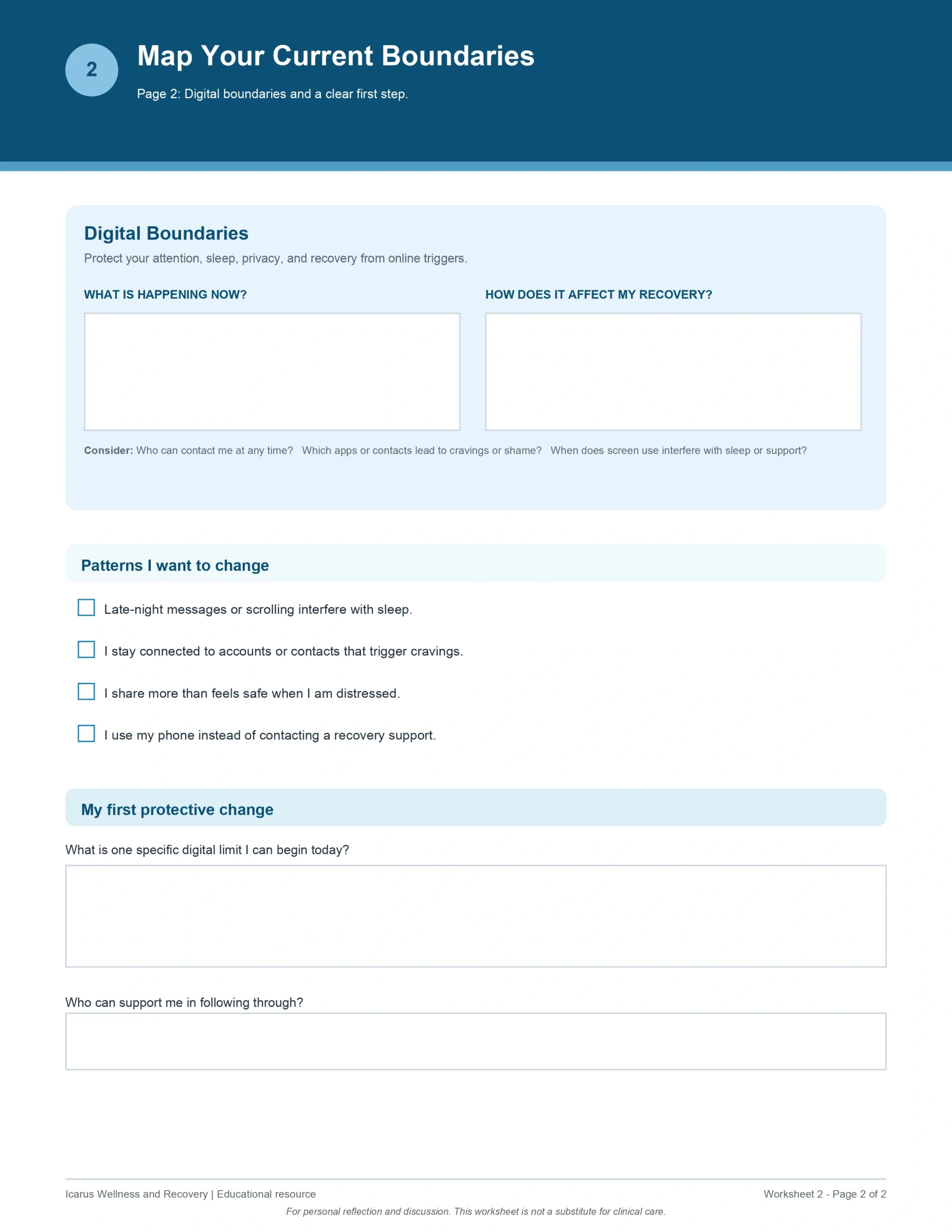
This two-sided worksheet helps visualize where current boundaries are strong, weak, or missing. It uses three clearly separated sections for physical boundaries, emotional boundaries, and digital boundaries, with light shading to distinguish them at a glance.
Each section includes:
- A brief one-sentence definition
- A column titled “What’s happening now?” with blank lines
- A column titled “How it affects my recovery” with blank lines
Physical boundary prompts:
- “Who or what is allowed in my living space?”
- “Are alcohol, drugs, or paraphernalia present anywhere I sleep or relax?”
- “Do I feel safe in my body around loved ones and acquaintances?”
Emotional boundary prompts:
- “Do I feel responsible for fixing other people’s feelings?”
- “Do I allow myself to feel angry, sad, or scared without apologizing?”
Digital boundary prompts:
- “Who can contact me anytime, day or night?”
- “Which apps or contacts usually lead to cravings or shame?”
The layout lets you see at a glance which boundary area may need attention first, making the recovery process more focused from the start.
Worksheet 3: Designing Healthy Boundaries for Recovery
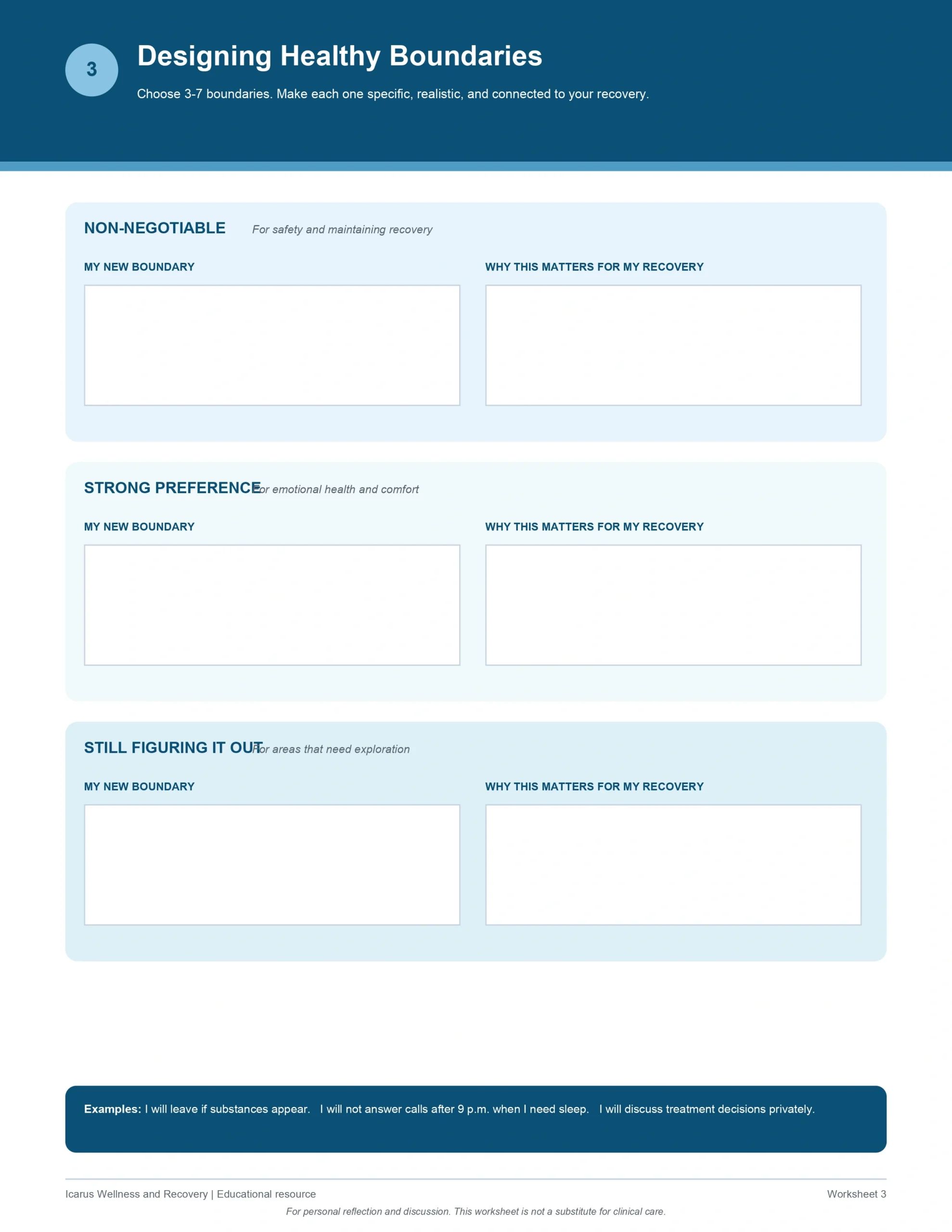
This planning page turns insights from Worksheets 1 and 2 into specific, actionable boundaries. The header encourages users to choose 3 to 7 boundaries to focus on so the page doesn’t become overwhelming.
The page is divided into three horizontal zones:
- Non-negotiable boundaries (for safety and maintaining sobriety)
- Strong preferences (for emotional health and comfort)
- Still figuring it out (for areas that need more exploration or self discovery)
Each zone includes a left column for “My new boundary” and a right column for “Why this matters for my recovery.” Actions in a worksheet include planning assertive communication and action planning, so this page bridges reflection with real behavioral change.
Concrete examples printed on the page include:
- Addiction recovery: “I will leave any gathering if people start using.” You should avoid social situations where drugs or alcohol are present.
- Mental health: “I will not answer calls after 9 p.m. when I need sleep to manage my mood.”
- Family dynamics: “I won’t discuss my treatment decisions during family gatherings or holidays.”
Setting healthy boundaries at this stage means turning your own thoughts about safety and comfort into written commitments that anchor your lasting recovery.
Worksheet 4 Offers Boundary Setting Scripts: What to Say and How to Say It
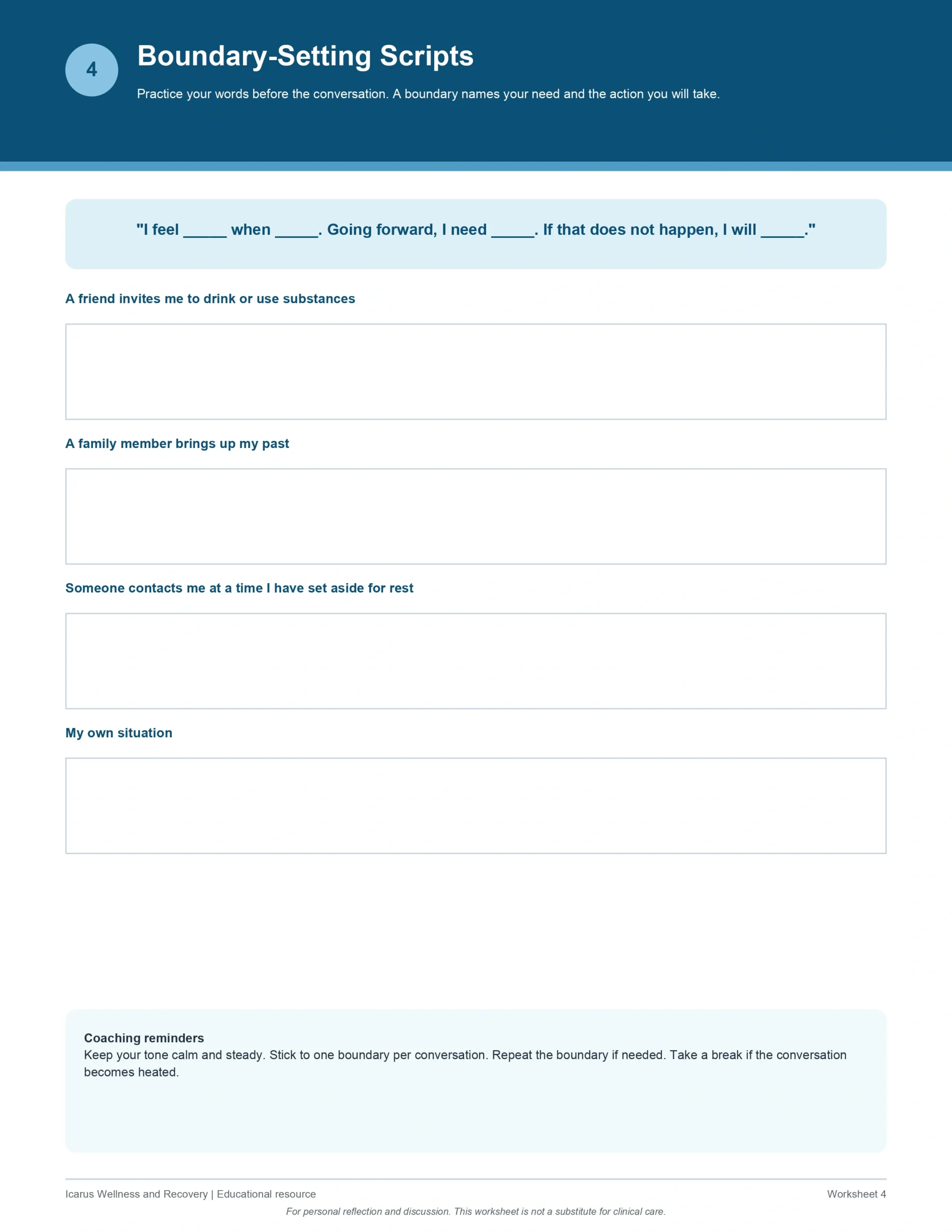
Many people know what boundary they want but freeze in the moment. This worksheet provides fill-in-the-blank scripts to reduce anxiety about recovery setting boundaries in conversation. Practicing assertive communication helps state needs clearly without aggression, and using “I” statements is recommended for expressing personal needs in a supportive manner.
The main formula is printed in bold at the top:
“I feel __ when __. Going forward, I need __. If that doesn’t happen, I will __.”
The worksheet offers 4–6 guided scenarios:
- “To a friend who invites you to drink: I feel __ when you __. Going forward, I need __. If that doesn’t happen, I will __.”
- “To a family member who brings up your past: I feel __ when __. Going forward, I need ____.”
Blank lines under each prompt let you write and rewrite until the wording feels natural. Communication boundaries define acceptable topics and conversation styles, and this page helps you practice setting boundaries before the real conversation happens.
A coaching tip box at the bottom reminds you to:
- Keep your tone calm and steady
- Stick to one boundary per conversation
- Calmly reinforce your boundaries if disrespected
- It’s okay to take a break if the conversation gets heated
This page works especially well in therapy groups where participants practice reading scripts aloud for confidence building.
Worksheet 5: An Internal and Online Boundaries Blueprint
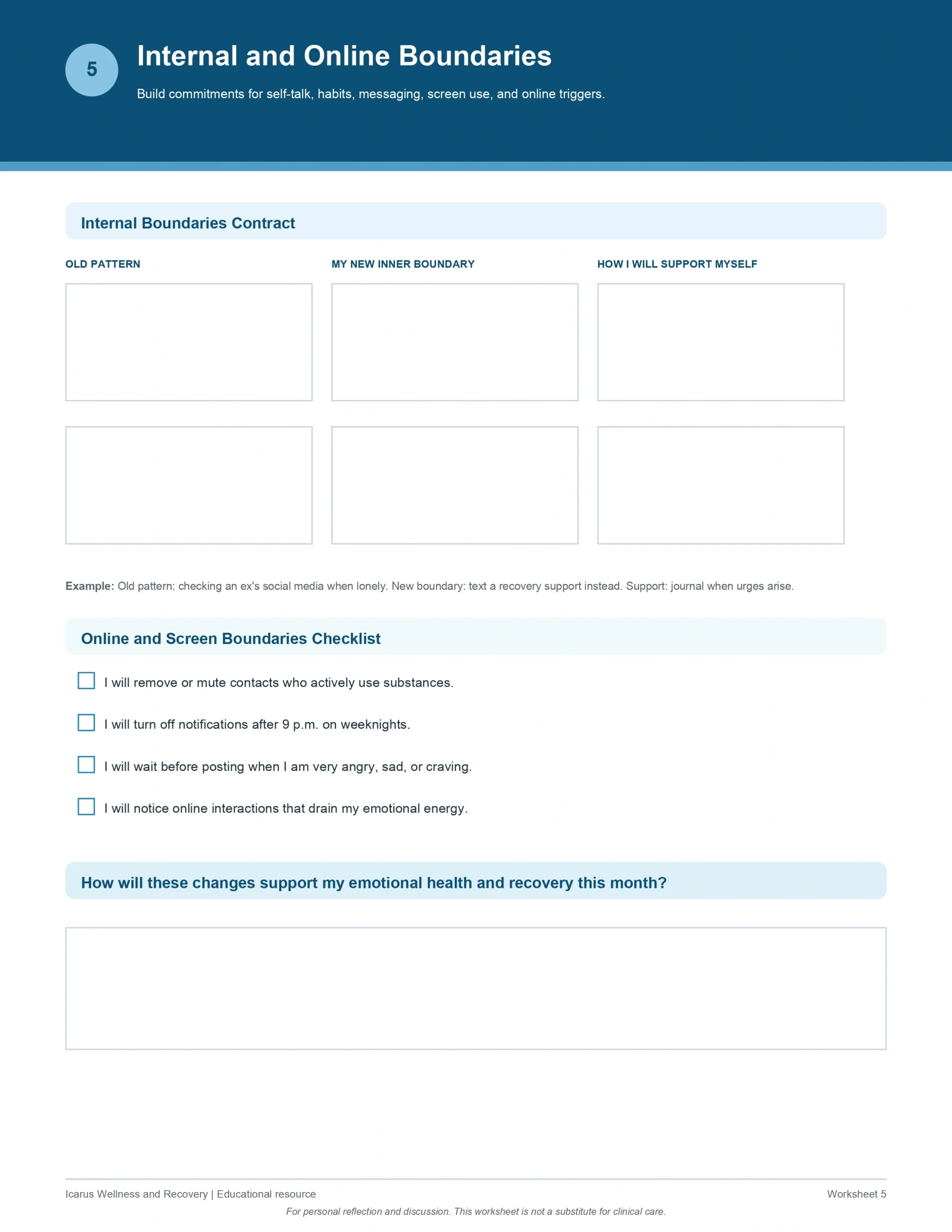
This worksheet focuses on two often-overlooked boundary types: internalized boundaries (self-discipline and self-talk) and technological boundaries (phone, messaging, and online life).
The top half is an “Internal Boundaries Contract” with three columns:
| Old pattern | My new inner boundary | How I will support myself |
|---|---|---|
| “Checking my ex’s social media when I feel lonely” | “When I’m lonely, I will text my sponsor instead” | “Set a reminder to journal when urges hit” |
| “Telling myself I’m a failure if I feel cravings” | “I will treat cravings as signals, not personal defects” | “Post affirmations on my bathroom mirror” |
| The bottom half is an “Online or Screen Boundaries Checklist” with checkboxes: |
- “I will remove or mute contacts who actively use substances”
- “I will turn off notifications after 9 p.m. on weeknights,” limiting screen time to protect rest
- “I will not post when I’m very angry, sad, or craving; I will wait 24 hours”
- “I will be mindful of online interactions that drain my emotional energy”
A reflection prompt closes the page: “How will these changes support my emotional health and sobriety this month?” with 4–5 lines for writing. These internal boundaries and digital commitments protect your mental well-being during the most vulnerable windows of your recovery journey.
Worksheet 6: Boundaries With Loved Ones Like Family, Partners, and Friends
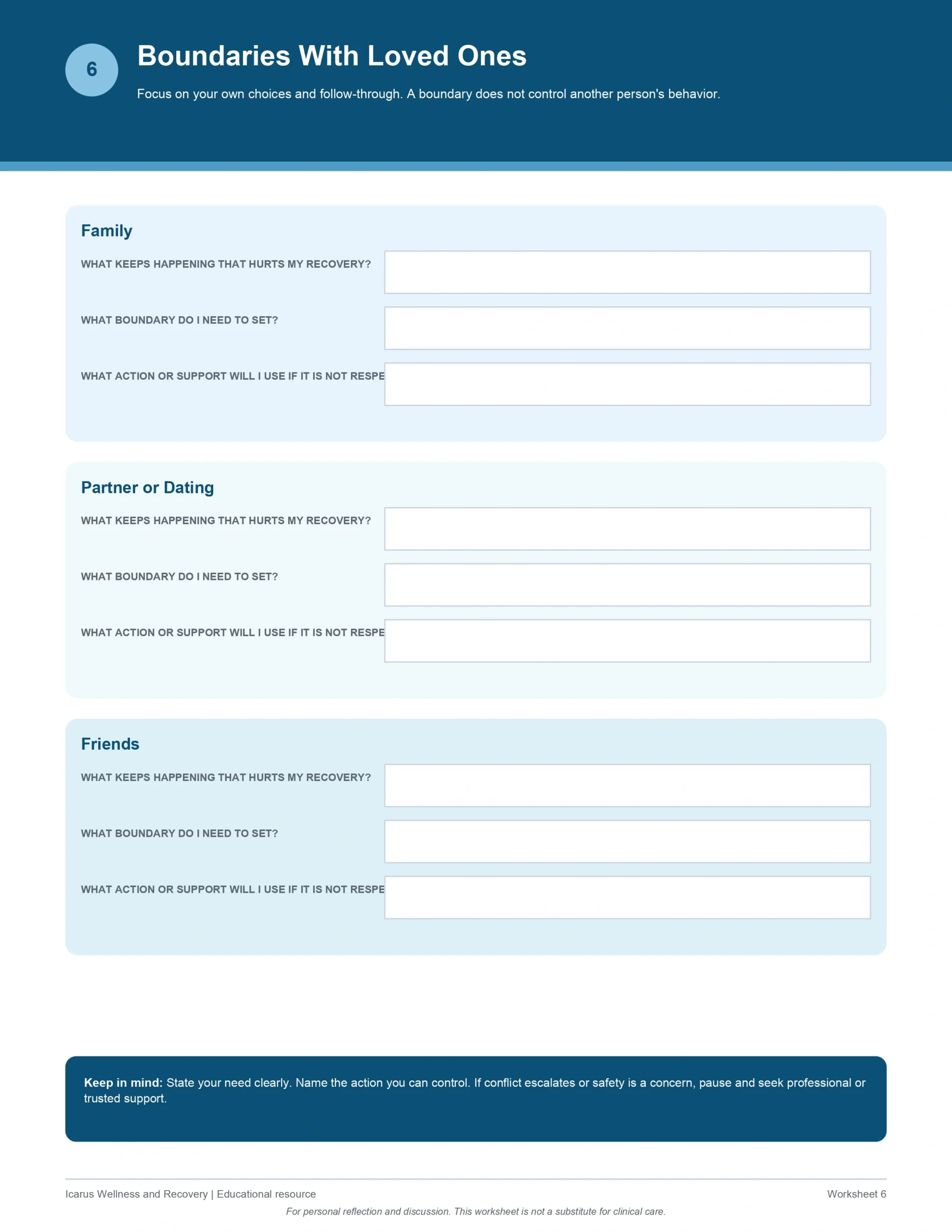
Setting boundaries with loved ones is often the hardest part of recovery because of history, guilt, and fear of conflict. Many people feel guilty when they first begin setting limits with family members or close friends, but your recovery is your responsibility, not others’ reactions.
The worksheet features three side-by-side mini-sections labeled “Family,” “Partner / Dating,” and “Friends,” each with the same three prompts:
- “What keeps happening that hurts my recovery?”
- “What boundary do I need to set?”
- “What support or consequence will I follow through on if this boundary isn’t respected?”
Example entries:
- Family: “Dad keeps asking about my court case in front of other relatives. Boundary: ‘I need to talk about legal stuff privately or not at all.’ Consequence: Step away from the conversation when he brings it up publicly.”
- Friends: “Old friends keep inviting me to bars. Boundary: ‘I don’t go to places focused on drinking now.’ Consequence: ‘If invitations continue, I’ll mute the group chat for a while.'” Limiting contact with those who disrespect your boundaries is sometimes necessary.
Communicate your needs clearly and assertively to loved ones, and maintain distance from people who negatively influence recovery. A small tip box reminds readers that boundaries are about your own actions and choices, not controlling others’ space or behavior.
Clinicians at Icarus may invite clients to bring this page into family sessions to guide calm, structured conversations and build healthy relationships.
Worksheet 7: A Weekly Boundary Review for Long Term Recovery
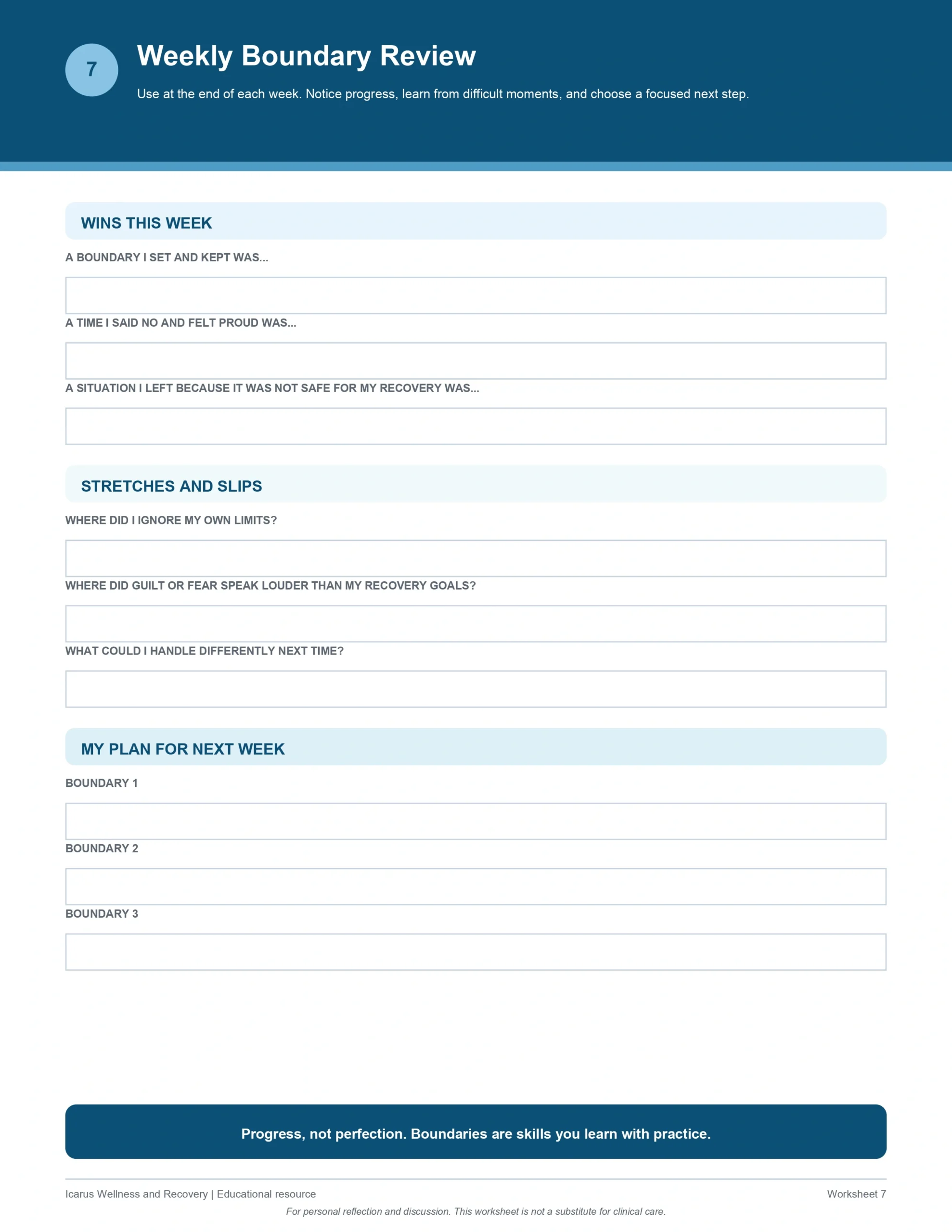
This one-page weekly check-in is designed to be printed multiple times and used every Sunday night or at the end of a treatment group cycle. Regular review of boundaries worksheets helps reflect current recovery needs and goals. Reassess your boundaries regularly as your recovery progresses.
“Wins This Week” includes bullet-style blanks:
- “A boundary I set and kept was…”
- “A time I said ‘no’ and felt proud was…”
- “A situation I left because it wasn’t safe for my recovery was…”
“Stretches and Slips” invites honest reflection:
- “Where did I ignore my own limits?”
- “Where did I let guilt or fear speak louder than my recovery goals?”
- “Did I feel frustrated by a situation I could have handled differently?”
“My Plan for Next Week” offers space to choose 1–3 focus boundaries (e.g., “stick to my sleep schedule,” “no texting people who are using,” “ask my partner for quiet time after meetings,” or “spend time on recovery activities instead of scrolling”).
A small footer encourages self-compassion: “Progress, not perfection. Boundaries are skills you learn with practice.” Keep these weekly pages in a folder to track growth over several months of long term recovery.
How to Use These Worksheets in Your Recovery: Alone, With Loved Ones, or in Therapy
There is no one “right” way to use our ‘Boundaries in Recovery Worksheet PDF’ series. It works solo, with trusted loved ones, or alongside professional support. The goal is simply to practice boundary setting until it becomes second nature.
Individual use:
- Set aside 30–45 minutes in a quiet place
- Start with Worksheet 1 and move in order
- Revisit Worksheets 3, 4, and 7 every few weeks as your personal needs change during the recovery process
With loved ones:
- Fill out Worksheet 6 before a planned family conversation
- Share selected parts (not the whole workbook) if that feels safer
- Agree on a calm time and neutral location for discussing new boundaries-not everyone needs to see every page
In therapy or group settings:
- Use a different worksheet as the focus of each session or group
- Invite clients to bring completed scripts to role-play boundary setting and practice self care in communication
- Review weekly check-ins to monitor progress in building healthier relationships
Icarus Wellness and Recovery clinicians often pair these worksheets with relapse-prevention planning, mindfulness exercises, and communication skills training to promote self-care and long-term sobriety within our accredited treatment programs in Idaho.
Whether you are breaking free from old patterns or deepening your early sobriety skills, these tools meet you where you are.
Icarus Offers An Extensive Catalog of Online Resources
Beyond our sheets and workbook that helps establish (and enhance) boundaries in recovery, Icarus Wellness and Recovery also provides a far-ranging array of prompts and worksheets used by facilities and mental health professionals across the country. Take a look below for our ever-growing range of supportive, interactive resources.
- Relapse autopsy worksheet and PDF
- Music therapy worksheets
- IFS therapy worksheets
- REBT worksheets
- Cognitive Processing Therapy CPT worksheets
- Recovery journal prompts
- Trauma timeline worksheet and PDF
- With more articles and resources published regularly, please check for updates and suggest upcoming topics to our team.
Getting Additional Support from Icarus Wellness and Recovery

Boundary work can stir up old emotions, trauma memories, or anxiety. If that happens, professional support is both helpful and appropriate. Seek support from a therapist to navigate boundary issues-especially if you have a history of intense relationship conflict or co-occurring mental health challenges.
Create a support system with understanding individuals who respect your recovery journey.
Icarus Wellness and Recovery offers comprehensive options, including inpatient rehab programs in Boise, as well as:
- Individual counseling focused on addiction recovery and mental health that can be matched to you using the ASAM levels of care for addiction treatment
- Group therapy where experienced professionals help you practice healthy boundaries in real time, with many services accessible through Pacific Source rehab coverage at Icarus
- Family sessions that help loved ones set and maintain boundaries together, with flexible private pay rehab options available for those using self-funded treatment
The same clinical principles behind these worksheets drive every Icarus program: a focus on emotional well-being, healthy relationships, and lasting recovery rather than quick fixes. If you would like a confidential conversation about whether boundary-focused support might help at your current stage, reach out to the Icarus team.
Even if you work with another provider, bring these worksheet concepts into your next appointment to guide the discussion, just as you might use a checklist when deciding what to bring to rehab for addiction and mental health. Boundaries are yours to own, and every step forward counts.
Medicaid and Many Forms of Insurance Accepted
FAQs on Boundaries in Recovery and Working to Improve Them
These FAQs address common concerns about timing, audience, and how worksheets connect to other recovery tools-questions that come up frequently but were not fully covered above.
Are these boundaries worksheets only for people in substance use recovery?
While many examples focus on addiction recovery, the worksheets also support people healing from codependency, burnout, people-pleasing, and emotional overwhelm. Partners, parents, and adult children of people in recovery can use them to clarify their own healthy boundaries.
How often should I redo the boundaries in recovery worksheets?
Redo the full packet every 3–6 months during your first year, or sooner after a major life change like a new job, move, relationship shift, or close call with relapse. Worksheet 7 is meant for ongoing weekly use, while Worksheets 1–3 are deeper check-ins to track growth over your leisure time in recovery.
Can I use these worksheets with my sponsor or peer support group?
Yes. The worksheets work well with sponsors, 12-step groups, SMART Recovery, or other peer-led meetings. Worksheet 4 (scripts) is ideal for role-plays, and Worksheet 6 fits naturally when discussing “people, places, and things” that threaten maintaining sobriety.
What if my loved ones get angry when I start setting boundaries?
Pushback is common when patterns change. Use Worksheet 4 to prepare calm responses, and remind yourself that protecting your recovery is not selfish-it is an essential aspect of your physical and emotional well being. If conflicts escalate, consider involving a therapist or mediator to help you set boundaries effectively.
Do I need professional help to benefit from the worksheet PDF?
Professional help is not required to start. Many people begin on their own and later bring pages into therapy. However, those with a history of trauma or severe mental health symptoms may find it safer and more effective to work through the material with a clinician, such as those at Icarus Wellness and Recovery.
References
- Providence St. Joseph Health. (n.d.). 6 types of boundaries.
- Tawwab, N. G. (2021). Set boundaries, find peace: A guide to reclaiming yourself. TarcherPerigee.
- Substance Abuse and Mental Health Services Administration. (2021). The importance of family therapy in substance use disorder treatment (Advisory, Publication No. PEP20-02-02-016).